March 25, 2008

Module: Fred Park - - - - - - Photo: Bill Grunklee
Welcome to the ’20s and ’30s Modular Model Railroad.
This is the interactive blogging version of our website. Feel free to post your comments.
We’re a modular model railroad club in the greater Los Angeles, California area. As you might guess from our name, we limit ourselves to the golden age of railroading between World War I and World War II.
Our next public show will probably be in early January 2009 at the Great Train Expo at the Anaheim Convention Center in Anaheim, California. When our space there is confirmed we’ll post details.
April 26, 2009

The ’20s & ’30s Modular Model Railroad will set up a small display at the San Bernardino, CA Amtrak station on National Train Day. Come on down….it’s free!
The station is adjacent to the Metrolink station so it’s easy to get there by rail.
If you’re driving, the address is 1170 West Third Street San Bernardino, CA 92410.
March 26, 2009
Bill Grunklee shot these photos on our layout at the Orange County Fairgrounds on March 21-22. His camera will focus on objects that are almost touching it!

A Pacific Electric Twelve rolls on the club's city corner module.

Pacific Electric cars are at rest on Dave McCanne's '20s-era module.

A stalled Essex on Charley Hepperle's module requires some attention.

A collision on Rich De Rosa's module leads to some wild arm waving.
March 18, 2009

Here's what the setup at a show looks like.
To give visitors a close-up look at our railroad, I installed a spy cam in a train going around the layout. It gives a live look at our world as if from a hobo looking out the door of a box car. To start the project, I took an HO box car and built a styrene box to hold a 9v battery.

After fitting in the components, we tried it out at our last show but were plagued by interference. A few seconds at a time of uninterrupted reception was all that we could get. With many radio-control throttles from ours and other layouts in the hall as well as DCC in the rails below the car we figured that adding a Faraday box around the video camera/transmitter would help.

Here’s the revised set-up showing the Faraday cage made of brass shim stock that will be grounded to the battery.

It took a lot of shoehorning to get it all to fit.

With the addition of an old rabbit ears antenna connected to the receiver, we tried it out at the Great Train Expo on March 21-22, 2009 at the Orange County Fairgrounds in Costa Mesa, California. The antenna and Faraday cage reduced interference enough that the image was watchable. Visitors had a great time trying to figure out which car had the camera. The view was particularly good on Dave McCanne’s module because it has a high backdrop on it that blocked out views of the convention hall and club members in the background.
Charley
December 5, 2008

Lionel steam loco
One of the things that influenced my interest in model trains were the Lionel 027 trains that I received in the ’50s. Santa Claus left a train set for me in 1957. Soon after, my cousin Richard gave me his two steam locos (one is shown above), a half-dozen cars and bunch of track and accessories. They survived many years of hard use. Eventually I stopped playing with them but kept them boxed up. In the ’80s I replaced missing bulbs and made minor repairs but the toy trains held no real attraction other than their sentimental value. I had started in HO scale railroading in the early ’70s and wasn’t about to change. Now, I’ve gotten tired of finding room to store them so I put them all up on that famous internet auction site. Despite their chipped paint (and my unfortunate attempts at “improving” some of them with poorly done detail painting when I was about ten or twelve) it looks like every one one will sell. Of course, my starting most of the auctions at 99 cents was a factor, especially when there was only a single bidder. But, I don’t care. I just want to send them all off to people who can enjoy them. About five years ago I set them up in the living room at Christmas time. It was OK but I never had the interest to repeat it. I’d rather spend my hobby time with scale model trains instead of toys so I have no regrets in letting them go.
October 13, 2008
Yes, it’s hokey but I’m building one anyway.
Here’s the story: in the ’30s California pumpkin and apple grower associations decided to team up to promote their products for Halloween in a new way. They decided to make up a train that would travel from town to town in their biggest market, southern California, for a few weeks in October. In each town, a grocery store would publicize the event and would have Halloween items to sell alongside the train when it arrived.

We don’t know for sure, but there’s a good chance that fellow who put it all together was a young man named P.J. Bresee. He talked the Pacific Fruit Express into loaning a ventilated reefer since the pumpkin growers were a good customer. He arranged to have a temporary sign attached that spelled out “Pumpkin Fun Express” while keeping the PFE reporting marks. He also had a couple of huge low-profile pumpkin shapes built of paper maché and nailed to the sides as attention getters. These changes could be easily removed without damaging the car when it was returned to the PFE.
The apple growers have a tanker decorated with a banner promoting apple cider.
When word of the promotion got around, a candy company offered to loan a billboard car with their name on it. This was about the time that the ICC declared that advertising on railroad cars had to end so this was probably the last time it would be seen before it got repainted.
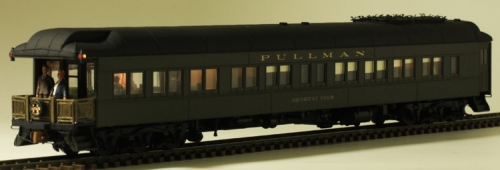
P.J. talked the Santa Fe into providing a loco and crew as a goodwill gesture for both the shippers and the public who would see the train. The engine will have a large scary mask tied on the front of the smokebox. Getting into the spirit of things, the railroad also provided a condemned 1890s parlor observation car that was on its way to the scrappers because of its wood body. The derelict condition of the car was not a problem as it would be a haunted house on wheels to entertain those brave enough to enter it at the promotional stops. High school students along the way would be hired to wear costumes and man the car.
There might be a flat car, too, carrying California’s heaviest pumpkin award winner from the state fair and decorated with jack-o-lanterns, ghosts, goblins and some washtubs for kids to bob for apples.
See the train on the ’20s & ’30s layout at the Los Angeles Division/NMRA Fall Meet in Rancho Palos Verdes on October 25 and 26. For details about the show, download a flyer at http://www.ladiv-nmra.org/trainshow.pdf
Charley
September 9, 2008

Photos of the club modules appear in the September 2008 issue of Scale Rails, the monthly National Model Railroad Association magazine. The two-page spread features the club as the winner of the first place group module award. Dave Toshak can be seen in the large photo and Dave McCanne in the one below it. Click on the photo to enlarge it.
July 19, 2008
The ’20s & ’30s display at the National Train Show in Anaheim this weekend is a roaring success. Set-up went smoothly and although there were some problems with radio-control interference, they were easily solved once we and the others figured out how to work on different frequencies. The new curtains look great thanks to Linda, Mike and Rich.
On Saturday morning, our club was awarded First Place in the modular model railroad group category. My Las Palmas module earned Best of Show in the modular model railroad individual category. Dave and Lucy had pizzas delivered for lunch — perfect!
Visitors were very appreciative of our efforts. We received many compliments from both NMRA members attending the convention in a nearby hotel as well as the public.
Thanks to the hard work of all the club members (and many of their spouses and family) we’re having a great time
I’ve posted photos at http://maisto.wordpress.com/2008/07/22/187-models-but-not-from-maisto/
Charley
July 7, 2008
Mike and Linda, his new wife, have graciously searched out the material and sewed it into new curtains to hide the legs of our modules. Rich has taken them to a firm for fireproofing. We’ll see them in use for the first time at the NMRA National Train Show at the Anaheim Convention Center on July 18-20. Thanks to all for helping make the club display look first class.
Charley
June 13, 2008
I’m plodding along. Leslie has finally graduated from USC and now I have more time to “play”. I’ve resumed the ground cover and hope to have more overhead wire hung in time for the Anaheim show. I enjoyed the article in “Railmodel Journal” , May 2008 issue. I sent a correction on the size of the module and the fact that all the travkwork was hand laid, not by Richard Orr. Anyway, it was quite an honor to be included in the magazine.
David McCanne
June 10, 2008
After much fiddling and monkeying around with a model airplane linkage and homemade bell crank, I’ve gotten the wig wags swinging like they’re supposed to. The signals (with the dummy control box at the base deleted) and the motor drive unit are from American Limited kits while the detector units are infra-red IRDOT circuits from Micro-Mark. A tiny spring inside the wig wag signal head pulls the target away from the pole. A piece of black thread attached to the top of the target shaft runs over to the pole and down inside it. Under the layout, the thread makes a ninety-degree turn and connects to a bell crank. A rod transmits back-and-forth movement to the bell crank from a lever that follows an eccentric cam rotated by an electric motor. When the detectors tell the wig wags to shut off, a circuit in the drive unit keeps the motor powered until the targets are hanging straight down as if by gravity.
Charley